
How would you build and operate a machine-learning system end to end, from problem definition to reliable production monitoring?
Interview preparation resource from Gate Smashers.
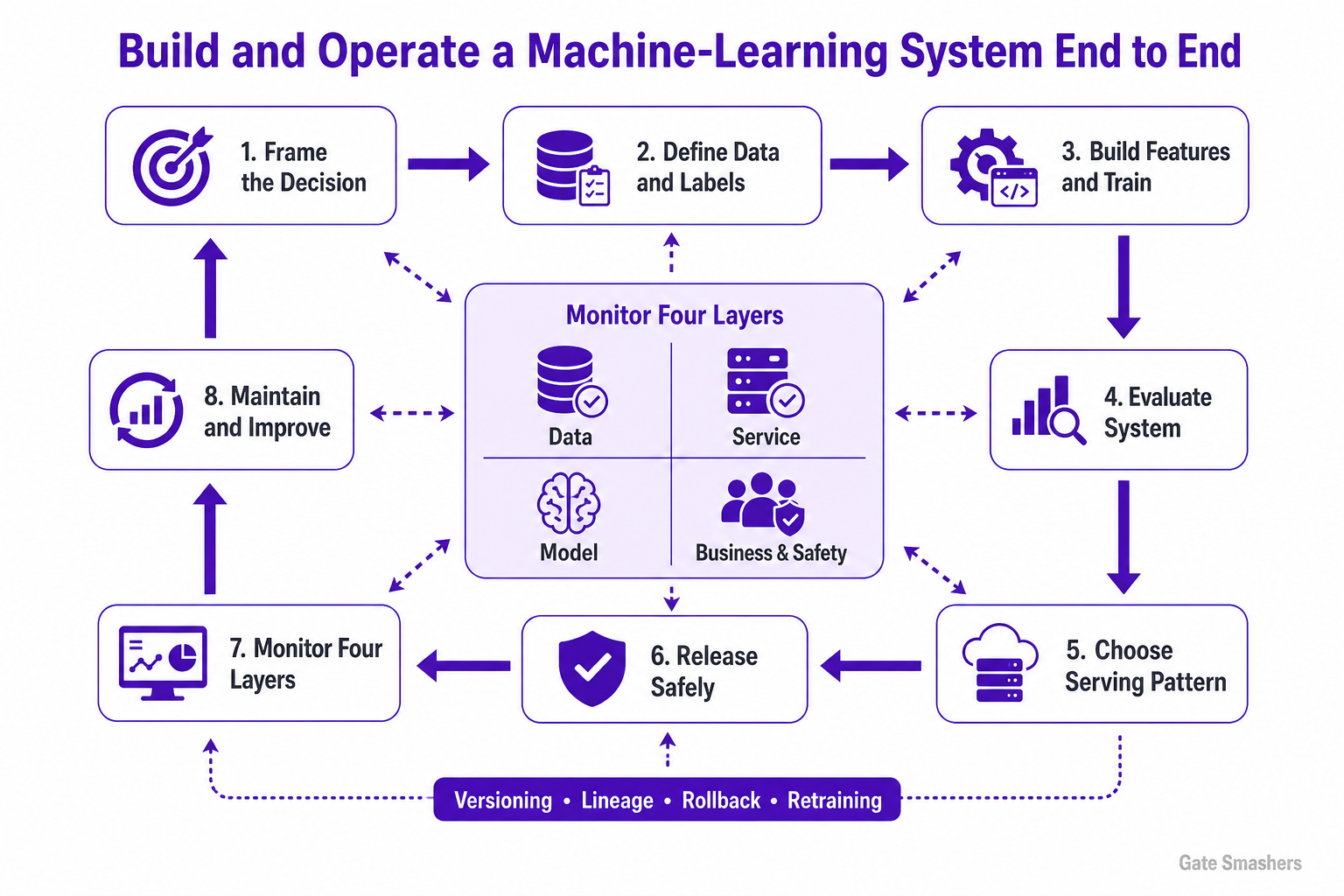
I would start with the business decision, users, constraints and measurable baseline; define labels and prediction-time features; build reproducible data and validation pipelines; train and evaluate candidate models with leakage-safe splits; package preprocessing with the model; deploy through shadow or canary stages; and monitor data quality, service health, model quality and business outcomes. I would also maintain versioning, lineage, rollback, retraining criteria and human review for high-risk decisions.
| Phase | Primary output | Critical check |
|---|---|---|
| Problem framing | Decision, objective, constraints and baseline | Metric matches real value |
| Data | Versioned dataset, labels and features | Prediction-time availability and no leakage |
| Training | Reproducible model pipeline | Tracked inputs, code and parameters |
| Evaluation | Offline and slice-level report | Untouched test and guardrails |
| Deployment | Versioned serving artefact | Shadow/canary checks and rollback |
| Monitoring | Data, service, model and business dashboards | Actionable alerts and owners |
| Maintenance | Retraining and incident process | Quality gates before replacement |
define_problem_and_metrics()
raw_data = load_versioned_data()
train, validation, test = leakage_safe_split(raw_data)
pipeline = fit_preprocessing_and_model(train)
tune_on(validation)
freeze(pipeline)
assert_quality_gates(evaluate(pipeline, test))
shadow_deploy(pipeline)
canary_release(pipeline)
monitor(data, service, model, business)
rollback_or_retrain_when_policy_triggers()1. Frame the decision
Specify who or what receives a prediction, when it is made, what action follows and what failure costs. Translate the business goal into an offline metric, online outcome and guardrail metrics. Establish a simple baseline before investing in a complex model.
2. Define labels and data boundaries
Document the prediction timestamp, label window, feature availability and entity keys. Build data-quality checks for schema, missingness, ranges, duplicates and freshness. Use time-aware or group-aware splits when the deployment setting requires them.
3. Build reproducible features and training
Keep transformation logic versioned and, where possible, shared between training and serving. Track dataset snapshots, code, features, hyperparameters, random seeds, metrics and model artefacts. Automate training through repeatable pipelines rather than notebook-only steps.
4. Evaluate the complete system
Compare with baselines and evaluate the metric that matches the decision. Inspect calibration, latency, fairness or safety constraints, robustness and performance slices. Tune on validation data and use an untouched test set for the frozen pipeline.
5. Choose a serving pattern
Design for feature freshness, throughput, latency, fallback behaviour and model-version compatibility.
- Batch inference: Appropriate when predictions can be computed periodically and latency is not immediate.
- Online inference: Appropriate when current context is required and request latency matters.
- Streaming inference: Appropriate when event-driven updates or near-real-time state are required.
6. Release safely
Validate the artefact, run integration tests and compare online features with offline expectations. Use shadow deployment to observe behaviour without affecting users, then canary or A/B rollout with automated and human-monitored guardrails. Maintain a rollback path.
7. Monitor four layers
- Data: Schema, freshness, missingness, ranges and distribution shift.
- Service: Availability, throughput, latency, errors and fallback rate.
- Model: Prediction distribution, calibration, segment metrics and performance when labels arrive.
- Business and safety: The actual outcome, guardrails, complaints and harmful failure modes.
8. Maintain and improve
Define who owns incidents, what triggers investigation or retraining and which approval gates a replacement must pass. Retraining may be scheduled, drift-triggered or performance-triggered, but every new model should be evaluated as a new release. Preserve lineage so a prediction can be traced to the data, features, code and model version that produced it.
Important interview point
A production ML system is more than a model endpoint. Data contracts, feature correctness, experimentation, deployment safety, monitoring and operational ownership usually determine whether the system creates lasting value.