
Explain encapsulation and de-encapsulation in computer networks.
Interview preparation resource from Gate Smashers.
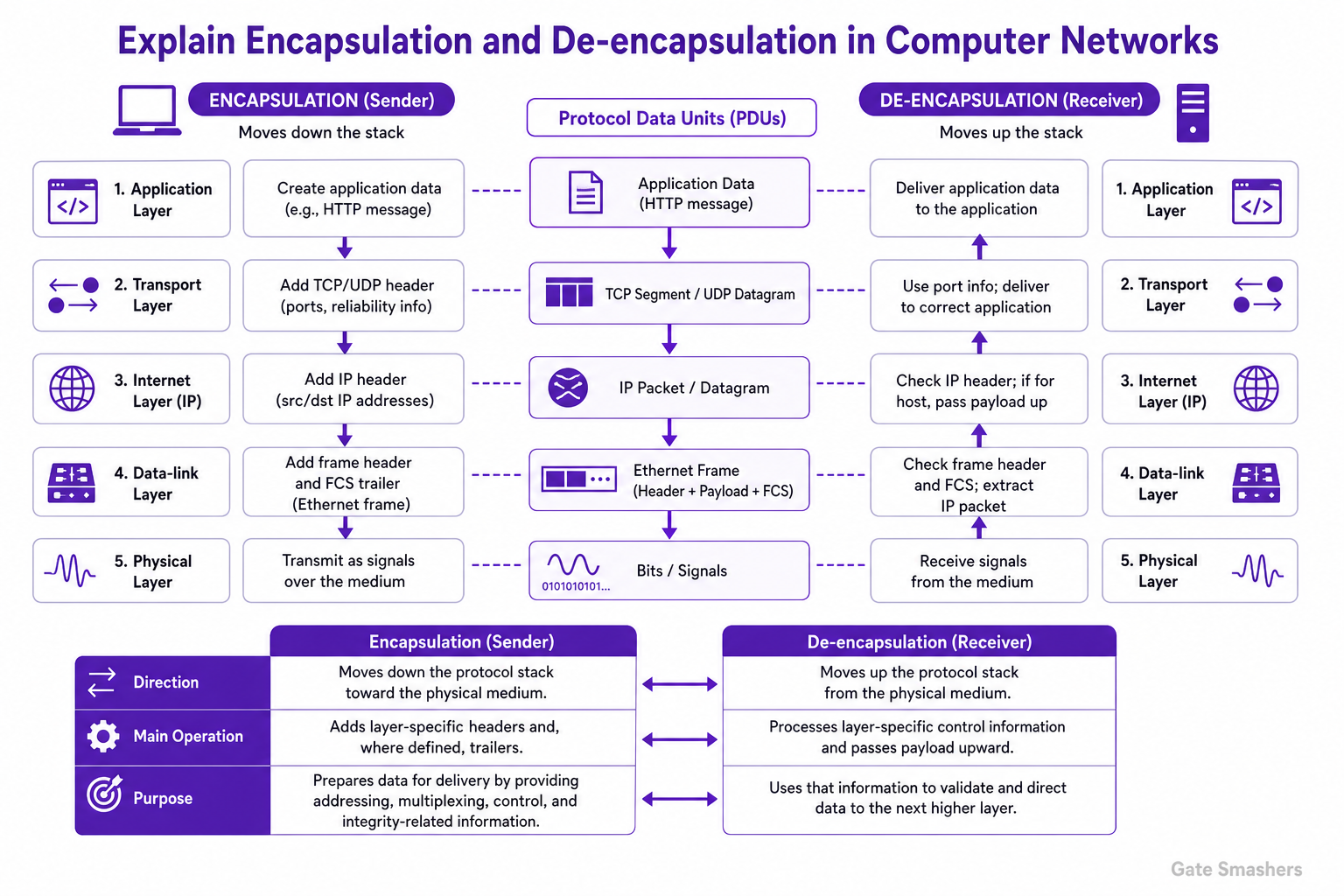
Encapsulation is the process of adding protocol control information to application data as it moves down the protocol stack at the sender. Each layer treats the data from the layer above as its payload and adds its own header, and some protocols also add a trailer. De-encapsulation is the reverse process at the receiver: each layer examines and processes its control information, removes it as appropriate, and passes the remaining payload to the layer above. For example, an HTTP message may be encapsulated in a TCP segment, then an IP packet, then an Ethernet frame, and finally transmitted as signals over the physical medium. At the destination, the Ethernet frame is processed first, followed by the IP packet and TCP segment, until the original application data is delivered to the appropriate application.
Concept
Encapsulation enables layered communication. A protocol layer adds information needed for its own function without requiring higher layers to manage lower-layer details. This information can include addresses, protocol identifiers, sequencing information, and integrity-checking fields.
De-encapsulation uses that information at the receiving system to identify, validate where applicable, and deliver the data to the next higher layer.
Encapsulation at the sender
As data moves downward through a TCP/IP-style stack, it is wrapped by successive protocol layers.
- Application layer: Creates application data, such as an HTTP message.
- Transport layer: TCP or UDP adds a transport header, including port information. TCP segments data and provides reliability-related control information; UDP forms a datagram with a simpler header.
- Internet or network layer: IP adds a header containing source and destination IP addresses, producing an IP packet or datagram.
- Data-link layer: A link protocol such as Ethernet encapsulates the IP packet in a frame. Ethernet adds a header and a frame check sequence trailer.
- Physical layer: Transmits the frame as signals over the selected medium.
De-encapsulation at the receiver
The receiving system processes the data in the opposite direction. The data-link layer accepts the frame and processes link-layer information. The IP layer processes the IP header and, if the packet is for the host, passes its payload upward. The transport layer uses the transport header, including the destination port, to deliver data to the appropriate application or service.
At each stage, a layer generally removes or does not forward the control information intended for that layer. The application ultimately receives the original application-layer data.
Protocol data units
The exact names vary by protocol and teaching model, but a common transmission sequence is: application data, transport segment or datagram, IP packet or datagram, data-link frame, and physical-layer bits or signals. The receiver processes these units in the reverse order.