
Why is a many-to-many relationship usually resolved using an associative entity?
Interview preparation resource from Gate Smashers.
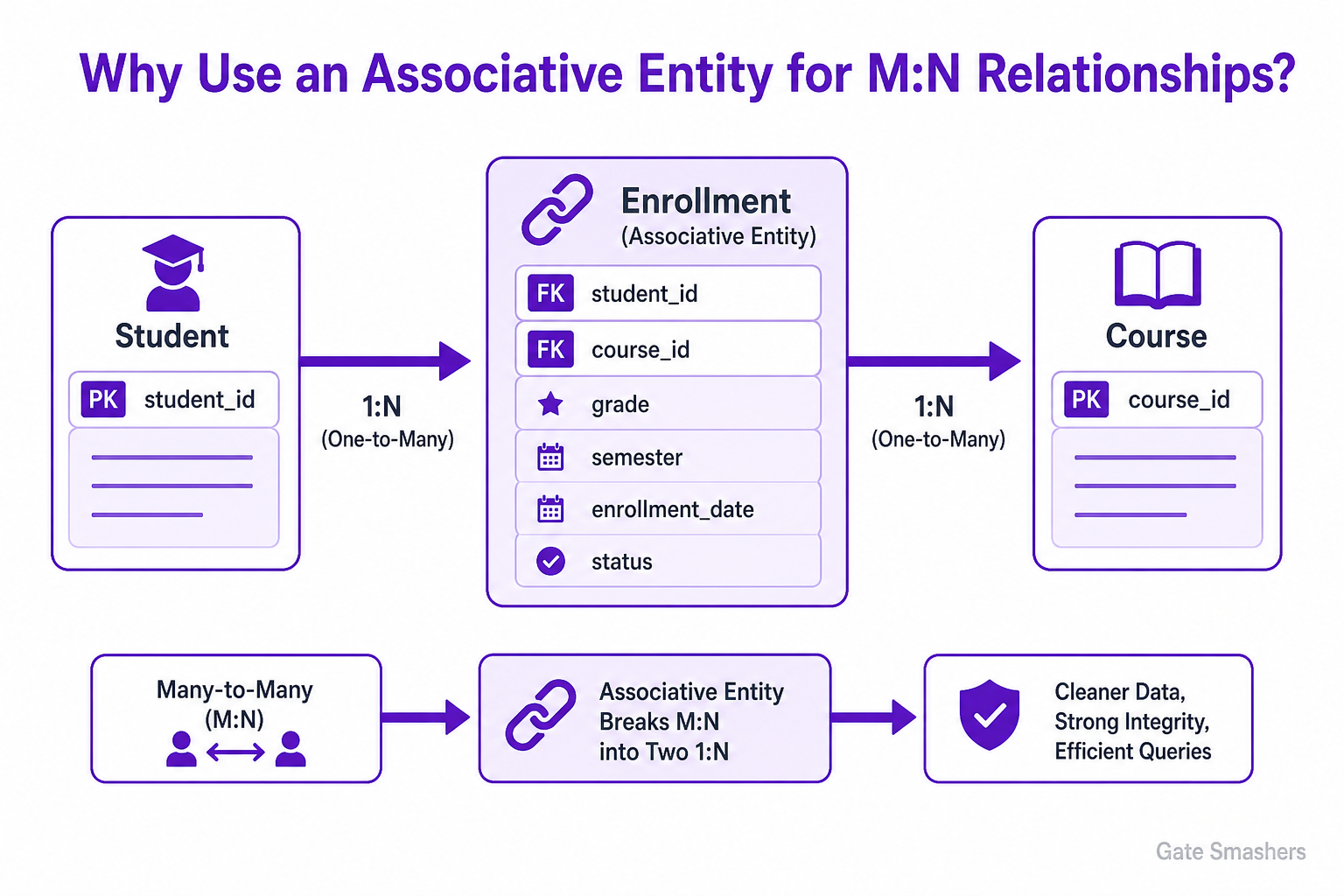
Because relational tables represent relationships through keys, an associative entity converts a many-to-many (M:N) relationship into two one-to-many (1:N) relationships. This avoids repeating course or student data in the other table, prevents update/repetition problems, gives each specific student–course pairing its own row, allows the relationship to store attributes (e.g., grade, semester, enrollment_date, status), and enables foreign key constraints and indexes for integrity and efficient queries.
Core reason
Relational tables model relationships using keys and foreign keys. An associative entity (associative table) represents each M:N link as its own row, turning one M:N relationship into two 1:N relationships. This is the primary reason many-to-many relationships are resolved with an associative entity.
How it works
The associative table contains the foreign keys of both participating entities; each row represents one specific relationship instance. For example, with students and courses, an associative entity named Enrollment holds the student and course foreign keys so Student -> Enrollment is one-to-many and Course -> Enrollment is one-to-many.
- Relationship mapping: Student -> Enrollment is one-to-many.
- Relationship mapping: Course -> Enrollment is one-to-many.
Why not store repeated data inside one side
If course information were repeatedly stored inside Student rows, or student information repeatedly stored inside Course rows, the design would create repetition and update problems. Repeated values make rows less clean and lead to difficulties maintaining correct, consistent data.
Benefits and enforcement
An associative entity centralizes the relationship and provides several practical advantages: it gives the relationship its own place to store attributes that belong to the relationship itself, foreign key constraints can enforce valid references to both entities, and indexes can be created on the relationship keys for efficient querying. Overall this produces cleaner rows, stronger integrity, and simpler queries than trying to represent the M:N relationship directly with repeated values.
- Relationship attributes: Enrollment can store grade, semester, enrollment_date, status, or other relationship data.
- Referential integrity: Foreign key constraints can enforce valid Student and Course references.
- Performance: Indexes can be created on the relationship keys for efficient querying.