
What is data independence, and why is it important in database systems?
Interview preparation resource from Gate Smashers.
Data independence means changes at one level of a database system can be made with little or no effect on the levels above it. It allows the database to evolve (for example, storage or schema changes) without forcing every application to be rewritten, improving maintainability.
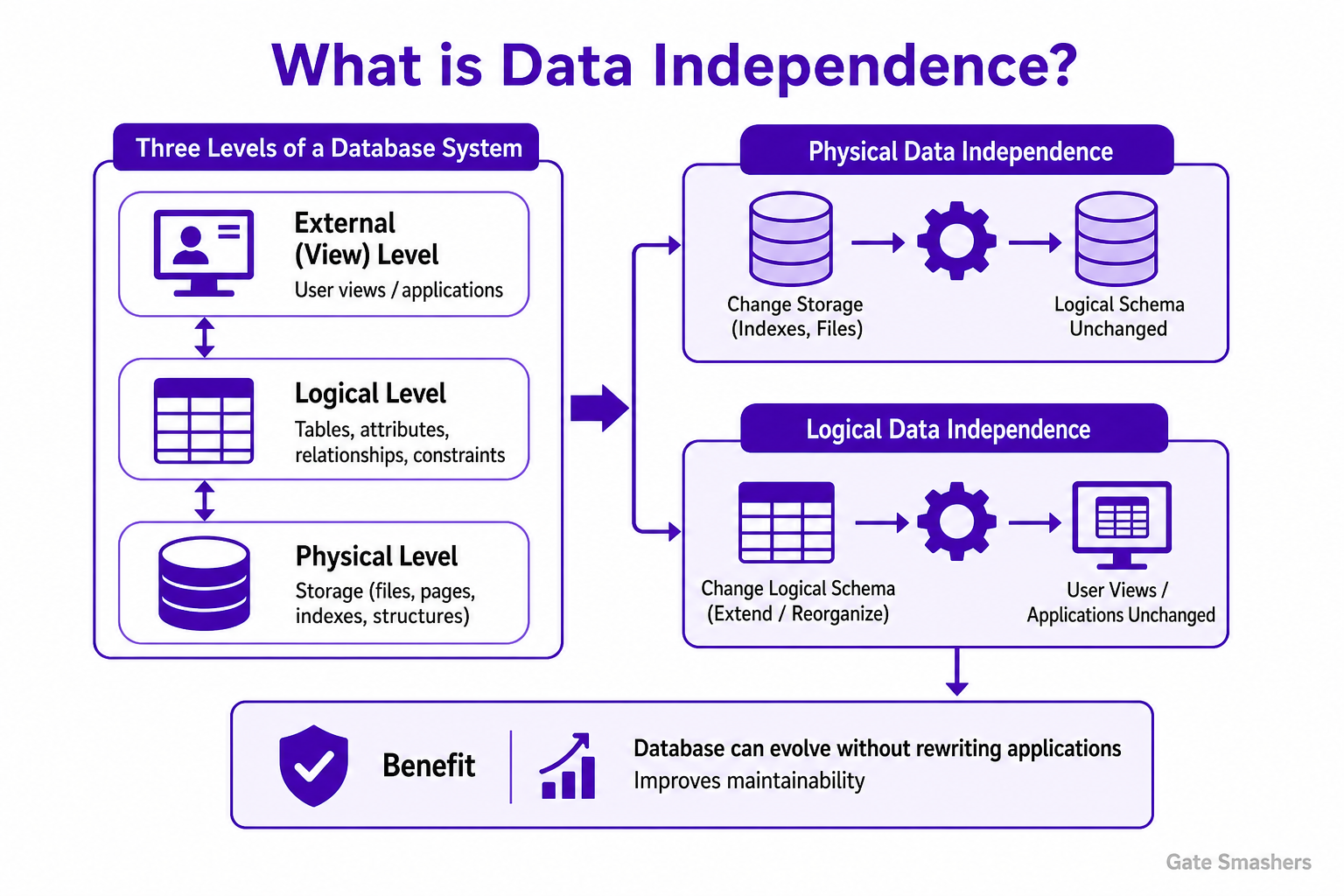
Definition
Data independence means that changes at one level of a database system can be made with little or no effect on the levels above it.
Three levels of a database system
Database systems are commonly understood at three levels; each level separates concerns so changes below need not affect the ones above.
- Physical level: Describes how data is actually stored (files, pages, indexes, storage structures).
- Logical level: Describes tables, attributes, relationships, and constraints.
- External (view) level: Contains the different views seen by users or applications.
Forms of data independence
There are two main forms of data independence, with examples of each.
- Physical data independence: Storage details can change without changing the logical schema. Example: the DBMS may add an index or reorganize files without requiring application changes.
- Logical data independence: The logical schema can change with minimal effect on user views or applications. Example: a table may be extended or reorganized while existing views continue to present the same required data.
Importance / Benefit
The major benefit is maintainability: database administrators can improve storage or evolve the schema without breaking every dependent program. Overall, data independence lets the database evolve without forcing every application to be rewritten. Physical data independence is generally easier to achieve than logical data independence because applications are more closely connected to the logical structure they use.